



The Claims Experience Is the Product: Why Insurtech Investment Is Shifting to Post-Loss
For years, innovation in auto insurance focused on pricing sophistication — telematics, better underwriting models, and more granular risk segmentation. But pricing has become table stakes. Most major carriers now operate with advanced rating models, and comparison shopping makes price transparency unavoidable.
The real competitive battleground has shifted.
It’s no longer the quote. It’s the claim.
Claims Is the Moment of Truth
Customers interact with their insurer most meaningfully during a loss. A minor fender-bender can instantly become a loyalty-defining moment. Was the process simple? Was the payment fast? Did someone communicate clearly?
Research consistently shows that claims satisfaction is more predictive of retention than premium competitiveness. In auto, where switching costs are low, this matters.
This is why insurtech capital and carrier innovation budgets are increasingly flowing into post-loss technology — especially auto damage claims.
From Cost Center to Experience Platform
Historically, claims was treated as an operational cost center: minimize loss adjustment expense, control leakage, and negotiate repair rates. Technology investments reflected that focus.
Today, leading carriers are reframing claims as a customer experience platform — one that directly impacts lifetime value.
Three shifts are driving this change:
1. Automation Enables Speed at Scale
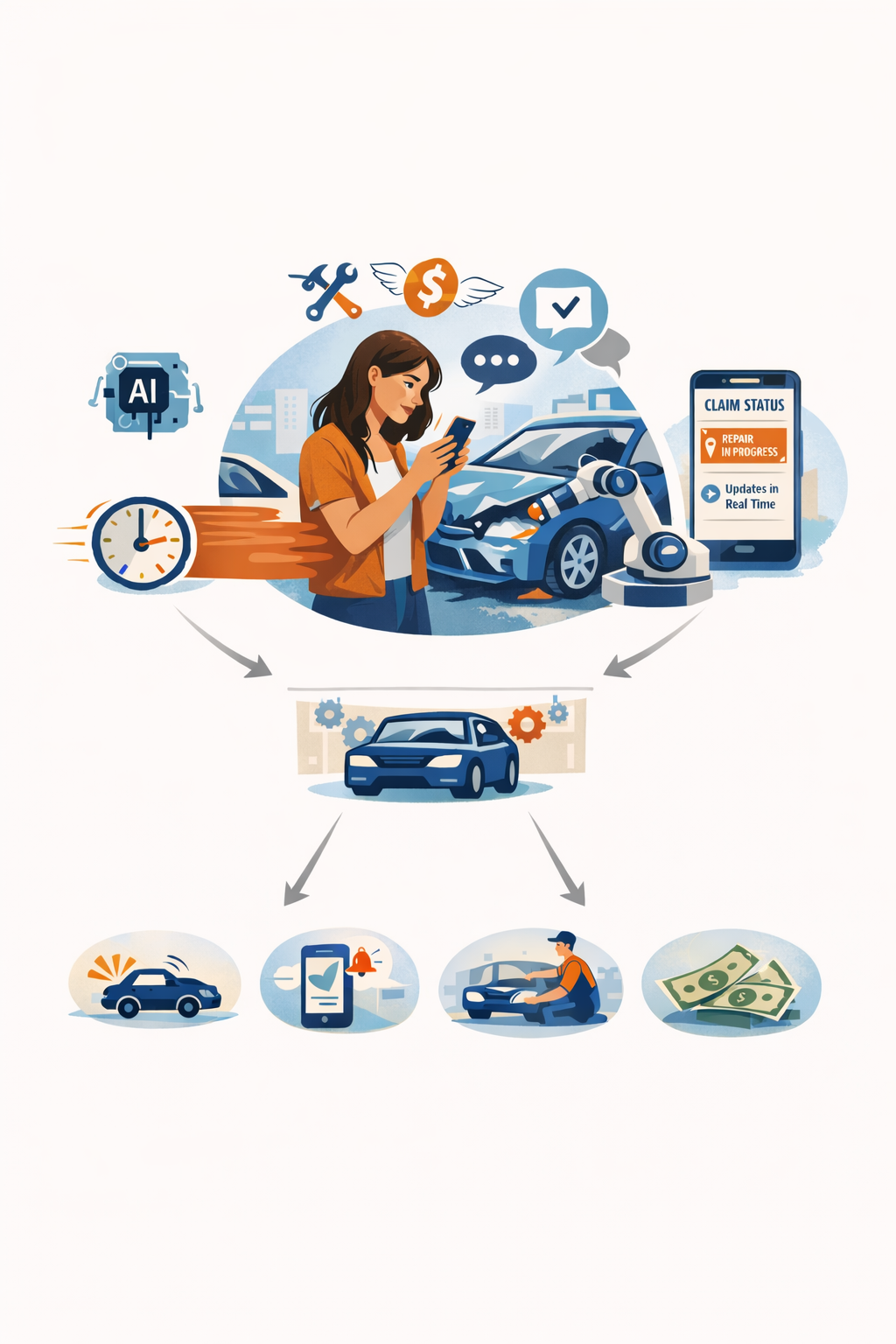
AI-driven photo estimating and computer vision now allow carriers to settle low-severity claims in hours instead of days. Straight-through processing (STP) isn’t just an efficiency play — it reduces anxiety during a stressful event.
Speed communicates competence. Competence builds trust.
2. Transparency Is Now Expected
Customers expect Uber-like visibility into progress. Modern claims platforms provide:
- Real-time status updates
- Repair milestone tracking
- Digital payment notifications
- In-app messaging with adjusters
Silence during a claim feels like failure. Communication is becoming as important as indemnity.
3. Data Feedback Loops Improve Outcomes
Digital integration with repair networks creates structured data around supplements, parts usage, and cycle time. This feedback loop reduces leakage while improving predictability.
The result? Faster claims without sacrificing accuracy — the historical tradeoff that slowed innovation.
The Economics Behind the Shift
There’s also a hard financial logic.
Acquiring a new auto customer can cost hundreds of dollars. Retaining an existing one costs far less. A seamless claims experience reduces churn and increases cross-sell probability.
In other words, post-loss investment isn’t just operational spend. It’s customer acquisition defense.
Some carriers are even modeling claims satisfaction into lifetime value calculations, directly linking claims NPS to pricing strategy.
The Competitive Landscape Is Changing
Insurtech startups initially tried to compete on underwriting and digital distribution. Increasingly, they’re differentiating on claims experience:
- Instant damage assessment
- Embedded repair scheduling
- Proactive total-loss resolution
- Automated rental coordination
Meanwhile, incumbent carriers are modernizing legacy claims cores to enable similar capabilities.
The real differentiator is no longer whether you can pay a claim — it’s how intelligently, quickly, and transparently you do it.
What This Means for the Next Decade
As vehicles become more connected and crash data becomes instantly available, the first notice of loss (FNOL) may become automatic. Claims could begin before the driver even calls their insurer.
In that world, claims isn’t reactive — it’s orchestrated.
The insurer that controls that orchestration layer — from crash detection to repair completion — effectively owns the customer relationship at the most emotionally charged moment.
That’s why insurtech investment is shifting downstream.
Because in auto insurance, the policy may be the product on paper.
But the claim is the product customers remember.

